




Key Points
- Asian equities advanced during Tuesday’s session, with technology-heavy markets in Taiwan and South Korea leading the recovery.
- Nvidia’s rebound helped restore risk appetite, while renewed expectations of US monetary tightening created a competing pressure.
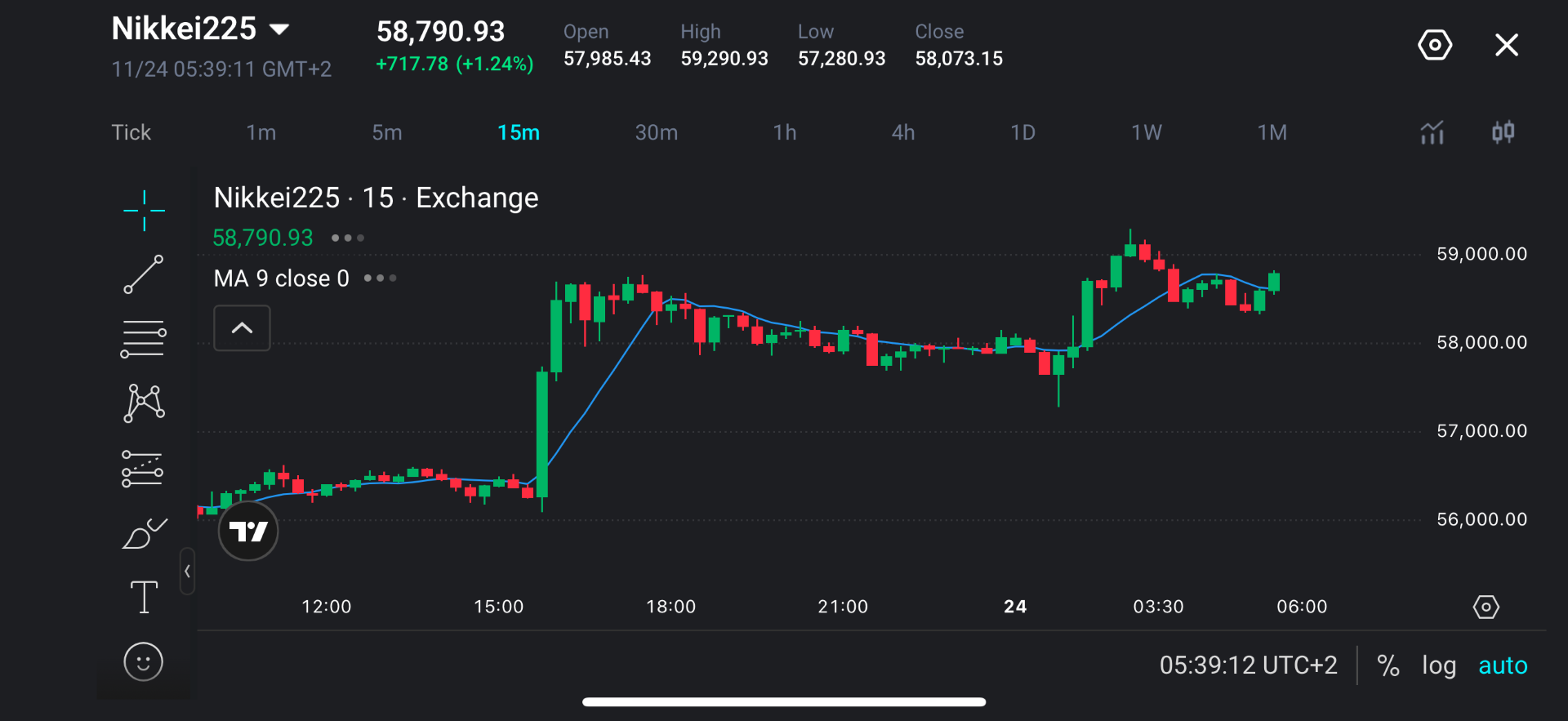
- Nikkei225 is trading near 58,790.93, with resistance at 59,000–59,300 and initial support around 58,350–58,500.
Market Move
Asian equities climbed on Tuesday, 24 November, as renewed confidence in the AI sector encouraged investors back into shares following recent heavy selling. MSCI’s broadest index of Asia-Pacific shares outside Japan gained 4.6%, recovering from an eight-month low. Taiwan’s benchmark jumped 9.1%, South Korea’s KOSPI rose 7.5%, and Japan’s Nikkei advanced 4.5% as Tokyo reopened after a public holiday.
For Japan, recovery now faces a technical test. Nikkei225′s recent session shows a sharp advance from the 56,000–56,600 region, followed by consolidation and another push towards 59,000.
Why Traders Are Watching
The main market catalyst was Jensen Huang’s return as Nvidia chief executive. Nvidia shares surged 31.5% on Monday, restoring almost $1 trillion in market value and lifting sentiment across the AI supply chain. Confidence towards Nvidia quickly spread across Wall Street and Asian markets. Reported gains include 13.2% for Advantest and 11.4% for Tokyo Electron during Tuesday’s session.
Improving risk appetite also revived expectations of Federal Reserve tightening. Markets fully priced a December rate increase, compared with 89% odds on Friday, while assigning 5% probability to a larger 50-basis-point move. Higher yields can pressure equity valuations, especially when prices depend heavily on future earnings growth. Although better AI sentiment supports buying, tighter financial conditions could still limit Nikkei’s gains.
Key Trading Levels
| Level | Significance |
| 59,000–59,300 | Main resistance around the psychological 59,000 level and recent high of 59,290.93. |
| 58,700–58,850 | Near-term decision zone around the latest price and nine-period moving average. |
| 58,350–58,500 | Initial support near the latest pullback lows. |
| 57,900–58,100 | Secondary support around the consolidation area preceding the latest advance. |
| 57,280–57,500 | Deeper support around the sharp downside wick and displayed low of 57,280.93. |
| 56,000–56,600 | Broader support at the earlier trading base before the initial rally. |
Nikkei225 is trading around 58,790.93 on the chart, following a recovery from the 57,280–57,500 support region. Price has moved back towards the upper side of the nine-period moving average, suggesting improving short-term momentum.
However, the index remains below its recent high of 59,290.93, with sellers emerging around 59,000–59,300. Buyers need to clear and hold above this zone to strengthen the case for an extension towards 59,500, followed by the psychological 60,000 level.
Bullish and Bearish Setups
| Setup | Trigger | Potential Market Reaction |
| Bullish Breakout | Break and hold above 59,300 | Momentum may extend towards 59,500, then 60,000 |
| Bullish Pullback | Hold 58,350–58,500 and reclaim 58,850 | Buyers may retest 59,000–59,300 |
| Bearish Rejection | Rejection at 59,000–59,300, followed by a break below 58,350 | Sellers may target 58,100–57,900 |
| Bearish Breakdown | Break below 57,900 and fail to reclaim 58,000 | Further downside towards 57,500, then 57,280, could develop |
The bullish breakout setup depends on Nikkei225 breaking above 59,300 and holding this level on a retest. This could support an advance towards 59,500, followed by 60,000. For a pullback setup, traders will watch whether support at 58,350–58,500 holds. A recovery above 58,850 could encourage another test of 59,000–59,300.
The bearish setup develops if Nikkei225 rejects 59,000–59,300 and falls below 58,350, bringing 58,100–57,900 into focus. A further break below 57,900, followed by a failed recovery above 58,000, would strengthen the bearish case and expose 57,500–57,280.
Disclaimer
The price levels and trade scenarios above reflect the author’s view at the time of writing and do not represent financial advice or an official recommendation from VT Markets. Traders should conduct their own analysis and manage risk carefully.
Nikkei225 Prediction: What Should Traders Watch Next?
The Nikkei225’s outlook depends heavily on AI sentiment. Continued strength in Nvidia and Japanese semiconductor shares could support the rally, while renewed concerns about AI spending could trigger profit-taking.
US PCE inflation, due on 25 November, could reshape Federal Reserve rate expectations. A hotter reading may lift Treasury yields and pressure equities, while softer inflation could support risk appetite. Tokyo CPI, due on 27 November, and yen movements are also key. Stronger inflation could reinforce Bank of Japan tightening expectations and strengthen the yen, potentially weighing on Japanese exporters.
Trade Nikkei225 with VT Markets
Traders looking to follow movements in Japan’s equity market can access Nikkei 225 index CFDs through VT Markets.
Trading index CFDs allows traders to take positions on both rising and falling market prices without owning the underlying shares. Through the VT Markets trading platforms, traders can monitor market movements, apply technical indicators and manage their positions using risk management tools.
Start a live trading account today and explore Forex pairs, gold, 24/7 trading and more.

Frequently Asked Questions
Why are Asian equities rising?
Asian equities rebounded as Jensen Huang’s return to Nvidia improved confidence in the AI sector. The recovery spread across regional technology shares, with Taiwan, South Korea and Japan posting strong gains.
Where is the nearest Nikkei225 support?
Initial support sits around 58,350–58,500, the latest pullback region. Below that, 57,900–58,100 is the more established consolidation zone.
Could Nikkei225 reach 60,000?
A move towards 60,000 becomes more plausible if price clears 59,300 and holds above the breakout area.
Which upcoming economic releases could move the Nikkei225?
US PCE inflation on 25 November could shift Federal Reserve rate expectations, while Tokyo CPI on 27 November could influence expectations for Bank of Japan tightening. Both could affect bond yields, currencies and equity sentiment.
What could cause the Nikkei225 rally to reverse?
Renewed weakness in AI shares, higher bond yields or rapid yen appreciation could undermine the recovery.







